The Welsh Not: The Dark History Behind the Welsh Language
Imagine being a child. Seven or eight years old. You arrive at school on a Monday morning and greet your friend in the only language you have ever known — the language your mother speaks, the language your grandparents sing in, the language of your home and your community and everything familiar to you.
A teacher hears you. Without a word they place a piece of wood around your neck on a piece of string. It is heavy and uncomfortable and visible to everyone in the room. It marks you out. It says that you have done something wrong.
The only way to get rid of it is to catch another child speaking the same language. Then you pass it to them. At the end of the day whoever is wearing it gets beaten.
This was not a dystopian fiction. This was the Welsh Not. And it happened in schools across Wales throughout the nineteenth century.
What Was the Welsh Not
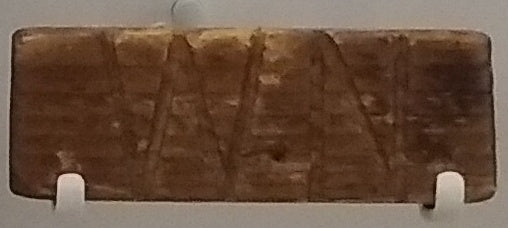
The Welsh Not, known in Welsh as Brad y Llyfrau Gleision (the Treachery of the Blue Books), was a wooden block or piece of slate — sometimes inscribed with the letters W.N. — that was used in Welsh schools to punish children for speaking Welsh.
The practice emerged in the years following the infamous Blue Books report of 1847, a government inquiry into the state of education in Wales that concluded Welsh people were ignorant, lazy and immoral, and attributed much of this to the Welsh language and nonconformist religion.
The report was deeply offensive to Welsh people and its conclusions influenced educational policy for decades. The message from the English establishment was clear: Welsh was a backwards language that held its speakers back. English was the language of progress, commerce and civilisation. Children who wanted to get on in the world needed to speak English.
The Welsh Not was the enforcement mechanism.

How It Worked
The system varied slightly from school to school but the basic principle was consistent. A wooden token — sometimes a piece of slate with W.N. carved into it — was given to any child caught speaking Welsh on school premises.
The child wearing the Welsh Not had to pass it on to the next child they caught speaking Welsh. It moved around the class throughout the day. At the end of the school day whoever was wearing it received a punishment, usually a beating.
The cruel genius of the system was that it turned the children against each other. It was not the teacher who policed Welsh speaking. It was the children themselves, motivated by the desire to avoid punishment. They became informants on their own classmates, their own friends, sometimes their own siblings.

The effect was profound. Children went home and stopped speaking Welsh to their parents. Parents, wanting the best for their children, stopped speaking Welsh to their children. Within a generation or two, Welsh speaking communities that had existed for centuries began to fall silent.
The Scale of the Damage
It is impossible to calculate precisely how many Welsh speakers were lost as a direct result of the Welsh Not. But the broader pattern of language decline through the late nineteenth and early twentieth centuries tells the story clearly enough.
In 1891 approximately 54 percent of the population of Wales spoke Welsh. By 1951 that figure had fallen to 29 percent. By 1981 it was down to 19 percent.
The Welsh Not was not the only cause of this decline. Industrialisation brought hundreds of thousands of English speaking workers into the south Wales coalfields. Emigration took Welsh speakers to other parts of the world. Radio and later television brought English into Welsh speaking homes in ways that were difficult to resist.
But the systematic suppression of Welsh in schools played a significant role in convincing generations of Welsh people that their language was something to be ashamed of rather than proud of. That shame, once planted, is difficult to uproot. It passes down through families in ways that are subtle and persistent. Welsh people who grew up in the mid twentieth century often describe parents or grandparents who could speak Welsh but refused to, who actively discouraged their children from learning it, who had internalised the message that English was the language of getting on and Welsh was the language of being left behind.
The Resistance
Not everyone accepted it. Throughout the period of the Welsh Not and beyond, Welsh people fought to maintain their language and culture.
The eisteddfod tradition, the annual celebration of Welsh language poetry, music and literature, continued and grew throughout the nineteenth century. Nonconformist chapels conducted their services in Welsh and became centres of Welsh cultural life. Welsh language newspapers and publishing houses kept the written language alive.
In the twentieth century the resistance became more organised and more political. Saunders Lewis gave a radio lecture in 1962 called Tynged yr Iaith (the Fate of the Language) that galvanised a generation of Welsh language activists. Cymdeithas yr Iaith Gymraeg, the Welsh Language Society, was founded the following year and pursued a campaign of direct action that eventually led to Welsh language road signs, Welsh language broadcasting and ultimately the Welsh Language Act.
S4C, the Welsh language television channel, launched in 1982 after a campaign that included Gwynfor Evans, the Plaid Cymru president, threatening to fast to death if the government did not honour its commitment to establish it. The government backed down.
Where We Are Now
The 2021 census recorded that approximately 17.8 percent of people in Wales speak Welsh. That is a slight decline from 2011 but the picture is more complex than a single headline figure suggests.
Among younger age groups the proportion of Welsh speakers is actually higher than among older generations — a reversal of the long term trend. Welsh medium education has created a generation of Welsh speakers in areas where the language had all but disappeared. Cardiff, which was not historically a Welsh speaking city, now has a significant and growing Welsh speaking community.
The Welsh Government has set a target of one million Welsh speakers by 2050. Whether that target is achievable is debated. But the direction of travel has changed.
The language that the Welsh Not tried to beat out of children is still here. It is on road signs and in schools and on television and in the mouths of people who learned it not because they had to but because they chose to. Because they understood what it means to carry a language and what is lost when one disappears.

Why It Still Matters
The Welsh Not is not ancient history. There are people alive today whose grandparents were punished for speaking Welsh at school. The consequences of that punishment ripple forward through generations in lost fluency, in fractured family communication, in a complicated relationship with a language that should have been a birthright.
Understanding the Welsh Not is understanding something fundamental about the Welsh experience. About why Welsh identity carries the weight it does. About why the language matters so much to so many people — even those who do not speak it themselves.
The wood block on the string is gone. But what it represents — the attempt to shame a people out of their own language and culture — is remembered.
And the language is still here.
Welsh identity survived everything that tried to erase it. If that means something to you, wear it. The word Cymru — the Welsh name for Wales — is a small act of cultural defiance every time it is spoken or worn. Our Red Wall Cymru T-Shirt carries it front and centre. Browse the full Welsh Designs collection, including Welsh tote bags and Welsh gifts — everything made in the spirit of a culture that refused to disappear.