
Y Ddraig Goch: The Story of the Red Dragon
The red dragon of Wales has been fought for, suppressed and reclaimed across more than a thousand years. This is the story behind Y Ddraig Goch, No.03 in the Made in Cymru collection.
There are national symbols that exist as decoration. Something to put on a flag, a badge, a souvenir mug. Something that looks the part without meaning very much to the people who carry it.
Y Ddraig Goch is not one of those symbols.
The red dragon of Wales has been earned. It has been fought for, suppressed, reclaimed and carried through more than a thousand years of Welsh history. It has appeared on battle standards in medieval wars, been dismissed by English authorities who insisted Wales had no flag, and been hoisted onto castle towers by Welsh patriots who disagreed. It did not become the most recognisable symbol of Welsh identity by accident. It became it through everything Welsh people put into keeping it alive.
This is that story.

Where it began
The origins of Y Ddraig Goch stretch back further than certainty allows. The oldest recorded use of the dragon to symbolise Wales appears in the Historia Brittonum, a history compiled around 830 AD and traditionally attributed to the monk Nennius. The symbol almost certainly predates that by centuries.
The connection begins with Rome. When the Roman legions occupied Britain they carried the draco, a military standard made of a carved animal head mounted on a pole with a fabric windsock body that made sounds as the wind moved through it. When the Romans withdrew from Britain in the early fifth century, the Welsh kings of Aberffraw in Gwynedd adopted the dragon standard as their own, using it to mark their authority in the power vacuum the Roman withdrawal had left behind.
The dragon had arrived as a Roman military emblem. It stayed as a Welsh one.
Merlin and the prophecy
The legend that fixed the red dragon in Welsh identity was recorded by Geoffrey of Monmouth in his 12th century Historia Regum Britanniae. It tells of Vortigern, a Celtic king searching for a site to build a castle, who chose the hillside of Dinas Emrys in Eryri. The castle's foundations kept collapsing. A young boy, later cast as Merlin, told him why: beneath the site lay an underground lake, and within it two sleeping dragons, one red and one white.
Vortigern's men dug and found the lake. The dragons woke and began a ferocious battle. After a long struggle, the red dragon won.
Merlin gave the meaning. The red dragon stood for the native Britons, the people who would become the Welsh. The white dragon stood for the invading Saxons. The red dragon's victory was a prophecy of Welsh survival and eventual triumph over those who sought to push them off their land.
It is a story about persistence. About a people who get knocked down and get back up. About a battle that takes a long time and ends the right way. That is what the dragon came to mean. Not just power. Endurance.
Cadwaladr and the red dragon of Wales
Around the seventh century the dragon became tied specifically to Cadwaladr, King of Gwynedd, who reigned from roughly 655 to 682 AD. It became known as Y Ddraig Goch of Cadwaladr, and through that association it became the emblem of the princes of Gwynedd and eventually of Wales as a whole.
Welsh court poets wrote of their leaders as dragons. The Welsh word draig, meaning dragon, was used to describe powerful leaders and warriors. A draig was not a mythical creature in Welsh poetry. It was a title, a mark of strength, authority and the kind of presence that made others follow.
Owain Gwynedd, Llywelyn ap Gruffudd, Owain Glyndŵr. Welsh leaders across the centuries were called dragons by their poets. The red dragon was not decorative. It was a statement about what kind of person you were and what kind of fight you were prepared to have.
Bosworth and the Tudors
The red dragon's most significant moment in English history came on 22 August 1485 at the Battle of Bosworth Field. Henry Tudor, of Welsh descent, carried the red dragon standard into battle against Richard III. He won. The Tudor dynasty began, and the red dragon was carried in state to St Paul's Cathedral in London.
The green and white of the Welsh flag as it exists today come from that moment. Green and white were the livery colours of the House of Tudor. Henry VII set them behind the red dragon, and those colours became part of the flag Wales would eventually fly.
The Tudors used the red dragon as part of the Royal Arms of England. When their dynasty ended and the House of Stuart took the throne, the Welsh dragon was replaced by a Scottish unicorn. The dragon came off the Royal Arms. It stayed on Welsh hearts.
The fight for official recognition
How the red dragon became the official flag of Wales in the 20th century is as characteristically Welsh as anything else in this history. Wales had to argue for it. Campaign for it. Climb castle towers and haul the Union flag down before anyone in authority took it seriously.
For decades in the early 20th century, Welsh people flew the red dragon at sporting and cultural events while official bodies insisted Wales had no national flag. Caernarfon town council spent years asking for the dragon to be flown on the Eagle Tower of Caernarfon Castle in place of the Union flag. In April 1916 the mayor, Charles A. Jones, who was also deputy constable of the castle, gave the reason for refusing: the authorities had been advised there was no such thing as a Welsh flag. It was only a badge.
The Welsh did not accept that. In 1932, when the Office of Works ignored a request to fly the dragon on the castle for St David's Day, a group of patriots settled it themselves. On 1 March they climbed the towers, hauled down the Union flags and raised the red dragon in their place. Castle officials took the dragon straight back down and put the Union flags up again. The point had been made anyway.
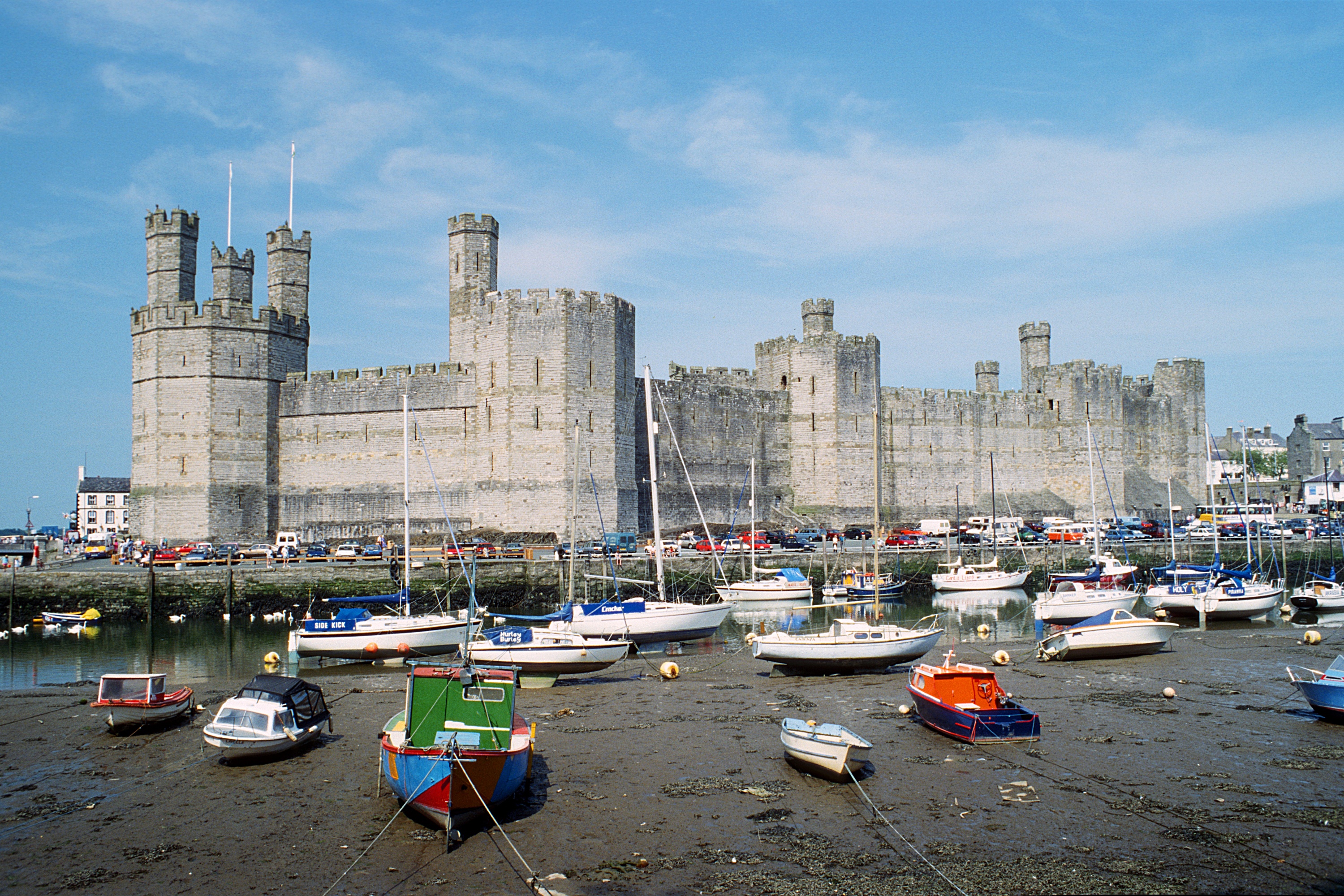
The campaign carried on for another generation. On 23 February 1959 the red dragon on a green and white field was officially recognised as the national flag of Wales. Not granted. Recognised. The Welsh had been flying it for decades. The authorities had finally caught up.
The motto tied to the Welsh royal badge puts it precisely. Y Ddraig Goch Ddyry Cychwyn. The red dragon leads the way.
What it means today
Y Ddraig Goch is on every Wales football and rugby shirt. It flies from the Senedd in Cardiff, from government buildings across Wales, from houses and pubs and car windows when Wales are playing. It travels to away ends across Europe in the hands of Red Wall supporters. It turns up in tattoos, in jewellery, and on the walls of Welsh homes across the diaspora.
For Welsh people living outside Wales it carries a particular weight. The dragon is the thing you wear when you want to say something true about yourself in a place where nobody asked. It is the signal to other Welsh people that you are one of them. The recognition across a crowded room. The nod.
It does not need explaining to the right person. It never has.
The design
The Y Ddraig Goch T-Shirt is number 03 in the Made in Cymru collection, one of the designs made for the ones that know. The design does not try to do too much. It does not need to. The symbol has more than a thousand years of meaning behind it. The job of the design is to carry that meaning, not add to it.
Worn by someone who understands what the dragon represents, it says everything without saying a word.
Shop the Y Ddraig Goch T-Shirt
Every number in the collection carries a story like this one. Read the ones behind No.01 Cymru, No.02 Yma o Hyd, No.04 The Red Wall, No.05 1958, No.06 1881, No.07 The XV, No.08 We Travel, No.09 Home Wherever We Are and No.10 The Catalyst.
Diolch,
Mike
